

The Question Nobody Has Asked You Yet — But It’s Coming
Your ESG department, your auditor, or a client asks for the CO₂ data from your last outdoor campaign — billboards, displays, point-of-sale materials.
How many kilograms of CO₂ were emitted in the production of each square metre printed?
Most brands cannot answer. Not because they don’t care about sustainability, but because large-format digital printing has never been treated as an auditable emissions line.
That is changing.
Visual Communication Is a Scope 3 Emissions Line — and It Can Be Measured
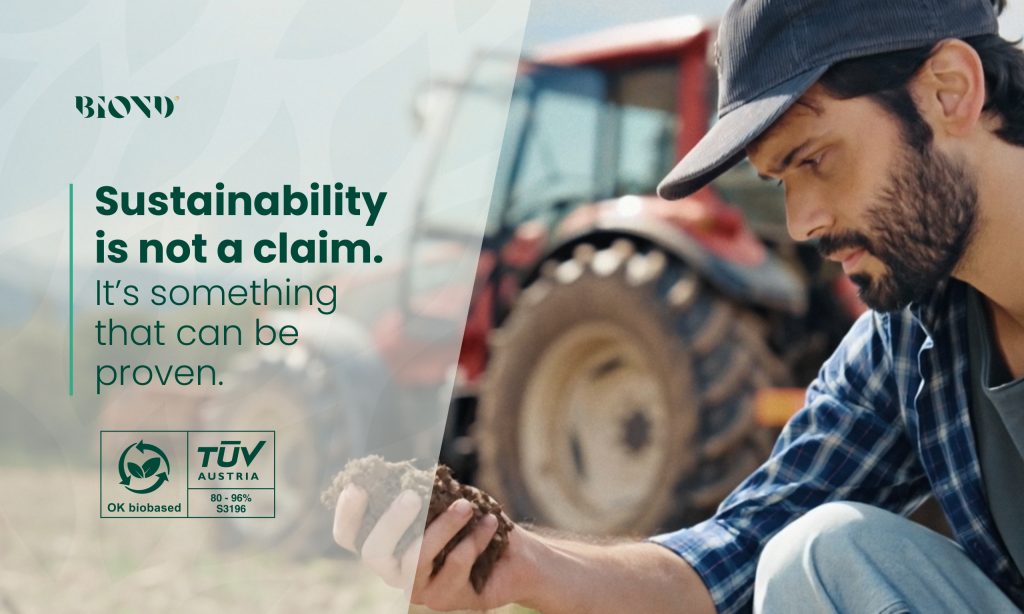
The difference between conventional print substrates and BIOND lies in the raw material. Conventional substrates are petroleum-derived. BIOND films are manufactured from bio-based sources, resulting in a verified CO₂ reduction certified by TÜV Austria.
The CSRD (Corporate Sustainability Reporting Directive) is increasing pressure on large companies to identify and report their Scope 3 emissions, which include indirect emissions from the supply chain — such as materials used in marketing campaigns. Major brands communicating in large format are realising that their campaign materials carry an environmental cost that is increasingly difficult to ignore.
The good news: a calculable alternative now exists.
What Are Biond Bio-based Films and Why They Change the Argument
Biond Bio-based Films are large-format digital printing films developed by Digidelta. They are manufactured from plant-based raw materials, with a bio-based composition between 80 and 96%, certified by TÜV Austria (OK biobased), and meet the needs of the main visual communication applications.
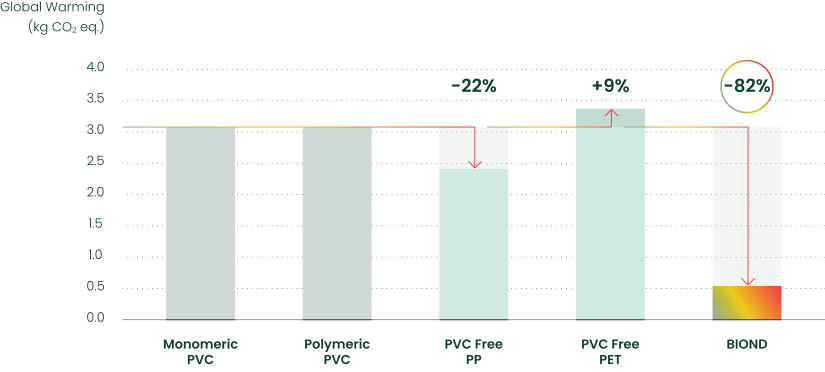
Compared to polymeric PVC — the most widely used material among large-format printing companies — Biond Bio-based Films offer the same usability in application and are compatible with the same printing technologies already installed. No equipment, processes, or suppliers need to change. The change is in the material. And that change enables a reduction of up to 88% in CO₂ emissions, proven by a Life Cycle Assessment (LCA) study developed by PIEP (Polymers Engineering Innovation Centre).
The Proof in Numbers: What Changes in a 10,000 m2 Campaign
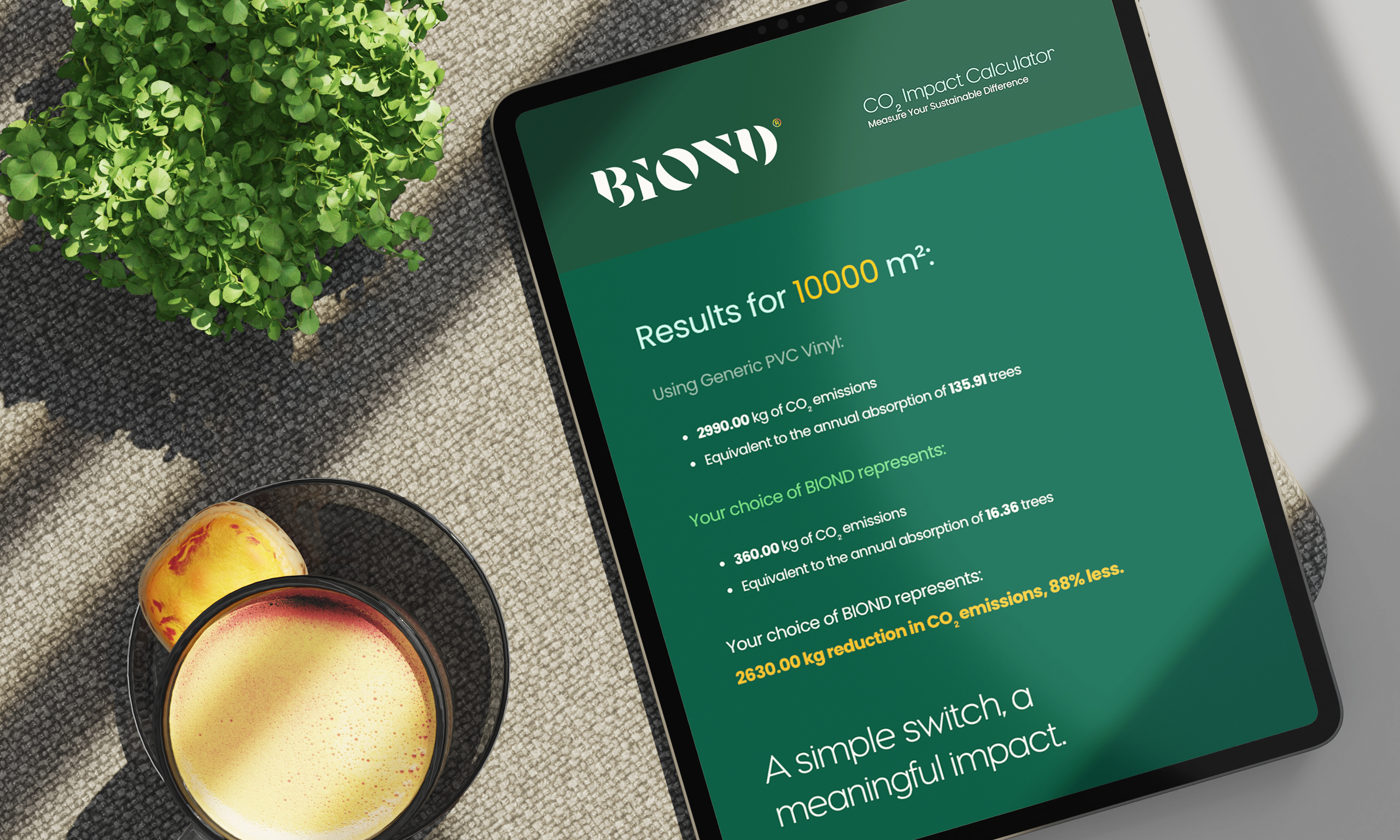
In a large-format visual communication campaign of approximately 10,000 m² of digital printing, the difference between a conventional PVC substrate and Biond films represents a reduction of 2,630 kg of CO₂ emissions into the atmosphere.
2,630 kg of CO₂ saved
Equivalent to 120 trees for one year
These figures come directly from the BIOND Calculator and are based on TÜV Austria certification and the Life Cycle Assessment (LCA) study developed by PIEP (Polymers Engineering Innovation Centre), following IPCC guidelines and the Ecoinvent v3.10 database — the same scientific reference used by the leading European sustainability reports. They can be used directly in external communications, ESG reports, and press materials.
One campaign. One verified number. One real argument.
For Your Brand — Where BIOND Films Make Sense
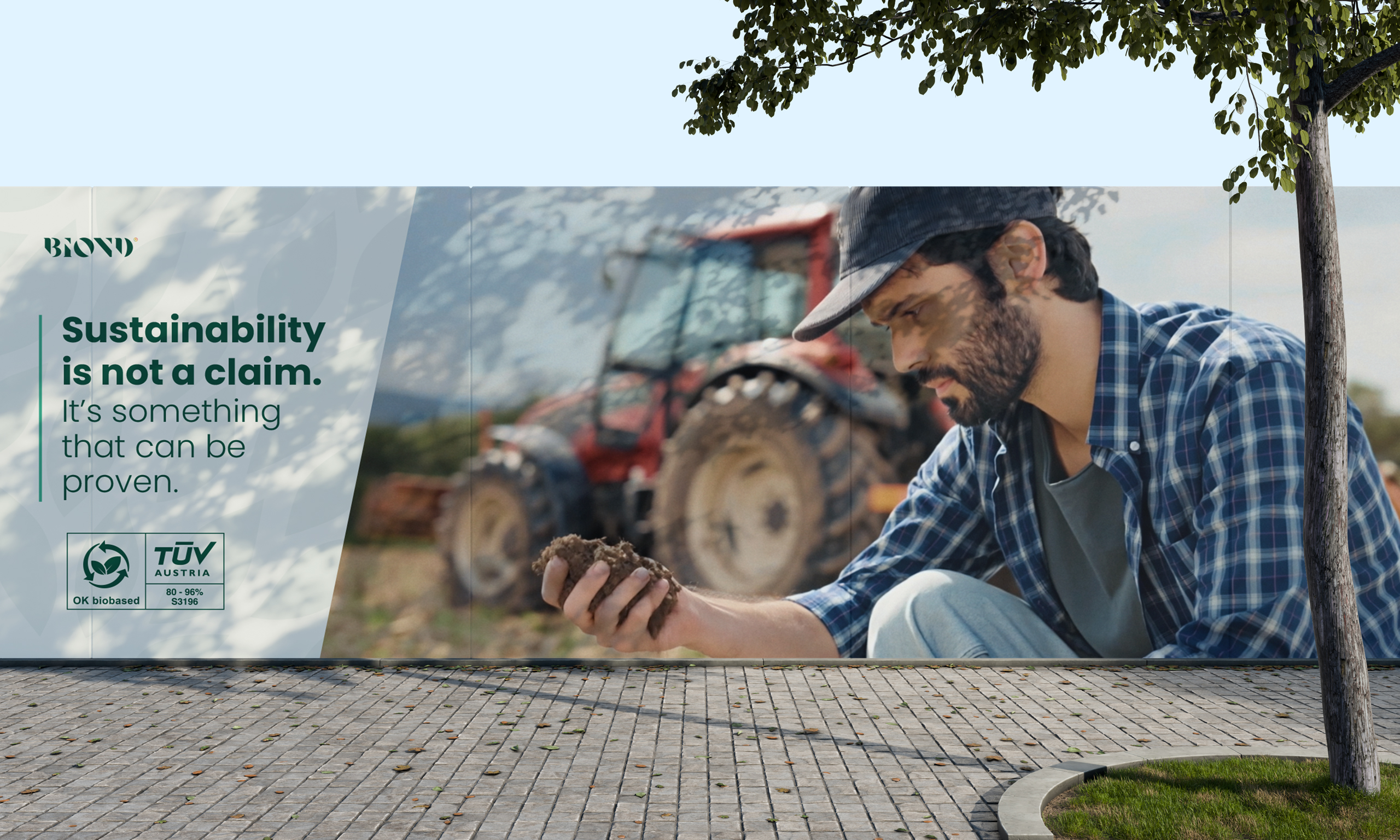
Biond Bio-based Films adapt to all large-format visual communication applications where brands are present:
- Outdoor communication (OOH), billboards, advertising panels, street furniture
- Retail and point of sale, displays, stoppers, floor graphics
- Events and activations, backdrops, stand materials, decoration
- Launch campaigns, decorative packaging, window displays, wrapping
- Internal and institutional communication, signage, office decoration
Just One Step to Get Started
Digi AI is an artificial intelligence assistant developed by Digidelta, available on WhatsApp.
Specialised in sustainability for digital printing, it helps Marketing Directors and ESG officers quantify the impact of their campaigns, prepare arguments for sustainability reports, and find BIOND-certified printing partners in their area.
The Moment
The regulatory direction is clear: verified Scope 3 data will be mandatory, not optional. The commercial direction is too: brands that get there first have a real competitive advantage — in reports, in tenders, and in communication with increasingly demanding consumers.
A simple change in printing materials. A significant impact for your brand and for the environment.